
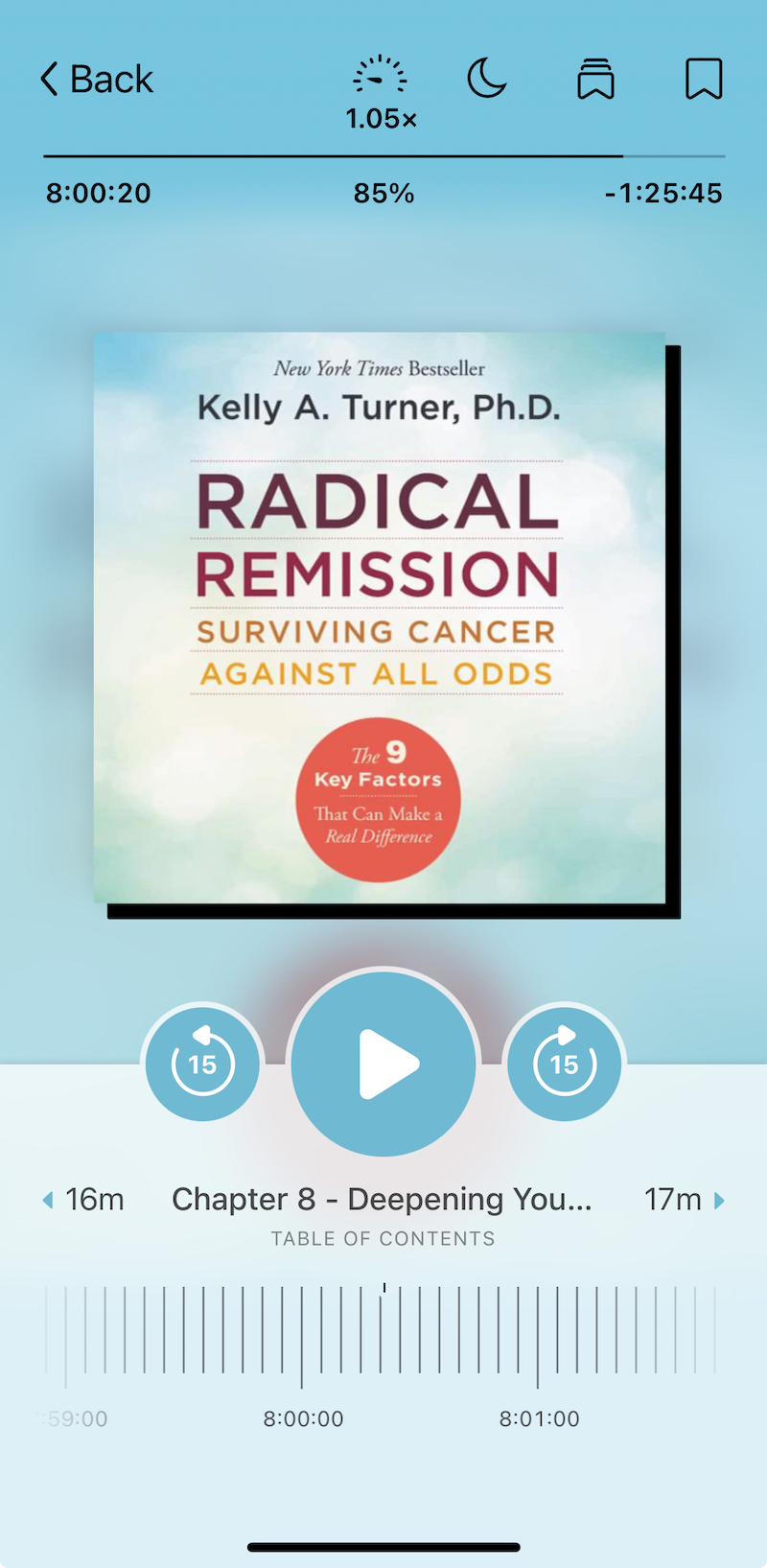
Radical Remission: Surviving Cancer Against All Odds
Kelly. A. Turner
I came across the title of this book in a reiki video. As a Reiki master who is fascinated by this energy healing modality, I was surprised to see this New York Times bestseller described as a resource for further reading on the subject. Finding the audiobook narrated by the author in the Singapore library system, I promptly checked it out and couldn’t stop reading it.
Before I proceed further –
Full disclosure – My day job as a pharmaceutical scientist involves working on medicines tried on cancer patients who have exhausted the standard treatment options that typically involve surgery, followed (or preceded by) multiple rounds of chemotherapy and/or radiation.
Back to Radical Remission: Surviving Cancer Against All Odds by Dr. Kelly A. Turner, founder of the Radical Remission Project. Turner tracked late stage cancer patients in ten countries and interviewed various holistic healers and tried to systematically categorise factors that the patients and healers believed were responsible for their mind-boggling recovery and return to good health. This was part of her Ph.D. research.
The book is not a thesis nor a scientific paper, nor is it simply a collection of anecdotes about miraculous cures that magically revived terminally ill patients. It is a deep dive into the psychology and practical wisdom of patients given dire diagnosis of various types of cancer which made them turn towards alternate modalities with a fervent desire to live. Right at the beginning we are informed that most oncologists have encountered patients who showed up in perfect health months or sometimes years after western medicine options had been exhausted and they had been recommended to go home or into hospice care. The phenomenon of ‘radical remission’ was not uncommon, it just was not well documented.
What I liked about the book was the way in which the author tried to find nine categories into which she could organise the information she collected from her interviews with real people – patients who were given months to live after being diagnosed with liver, pancreatic, ovarian, prostate and other cancers. Every one of the survivors (some who have lived for more than 20 years after their diagnosis), took responsibility for their life and treatment into their own hands. Most used a multi-pronged approach typically involving diet and lifestyle changes, use of supplements, and alternate treatment modalities ranging from energy healing to sound baths and many other approaches that helped dislodge emotional pain, buried trauma and deep grief.
Many of the stories are truly miraculous. Like the story of the woman with liver cancer whose scans showed a mass despite her looking and feeling better after her holistic regimen and reluctantly agreed to surgery. The surgeons were amazed to find that her cancer had completely gone and the mass on her liver could be easily snipped off with no adverse consequences. Or the stressed but successful businessman in Japan who escaped his hospital room, moved to a different city and focused on healing himself by eating healthy, breathing deeply and reconnecting with his childhood passion for music. Other stories speak of love (of family, of community) being the magic ingredient, or the deep desire to live (she wanted to be a grandmother who was fully involved in the lives of her grandchildren).
Perhaps the biggest “aha moment” for me was the link between our immunity and our ability to fight something as serious and insidious as cancer. Immunotherapy in cancer treatment is a buzz word but if we dig deeper, we can see that our modern lifestyles lead us down the road of reduced immunity thereby exposing us to not just infections but more serious illnesses which become harder to cure. Chemotherapy reduces immunity further and makes it doubly difficult for the body’s natural protective healing mechanisms to step up. With integrative and holistic treatment modalities, the approach focuses on bringing the whole body into a state of cooperative action wherein physical health is improved by stimulating its innate ability to return to its normal state by involving the mind and emotions and spiritual practices that get to the root of the disease.
Every chapter describes the path chosen by the patients, the reasons why some of the interventions or treatment choices may have logical reasons for contributing to the cure, real stories narrated by the patients, and a small section for what we as readers can do to integrate practices to improve our health.
My opinion: Read this book if you are interested in cancer research, are worried about a friend or family member who has been diagnosed or are skeptical about alternative modalities for cancer treatment. It will definitely be eye opening.



0 Comments