
What does it take for a person to visit a historic place of interest that is just down the road from their home?
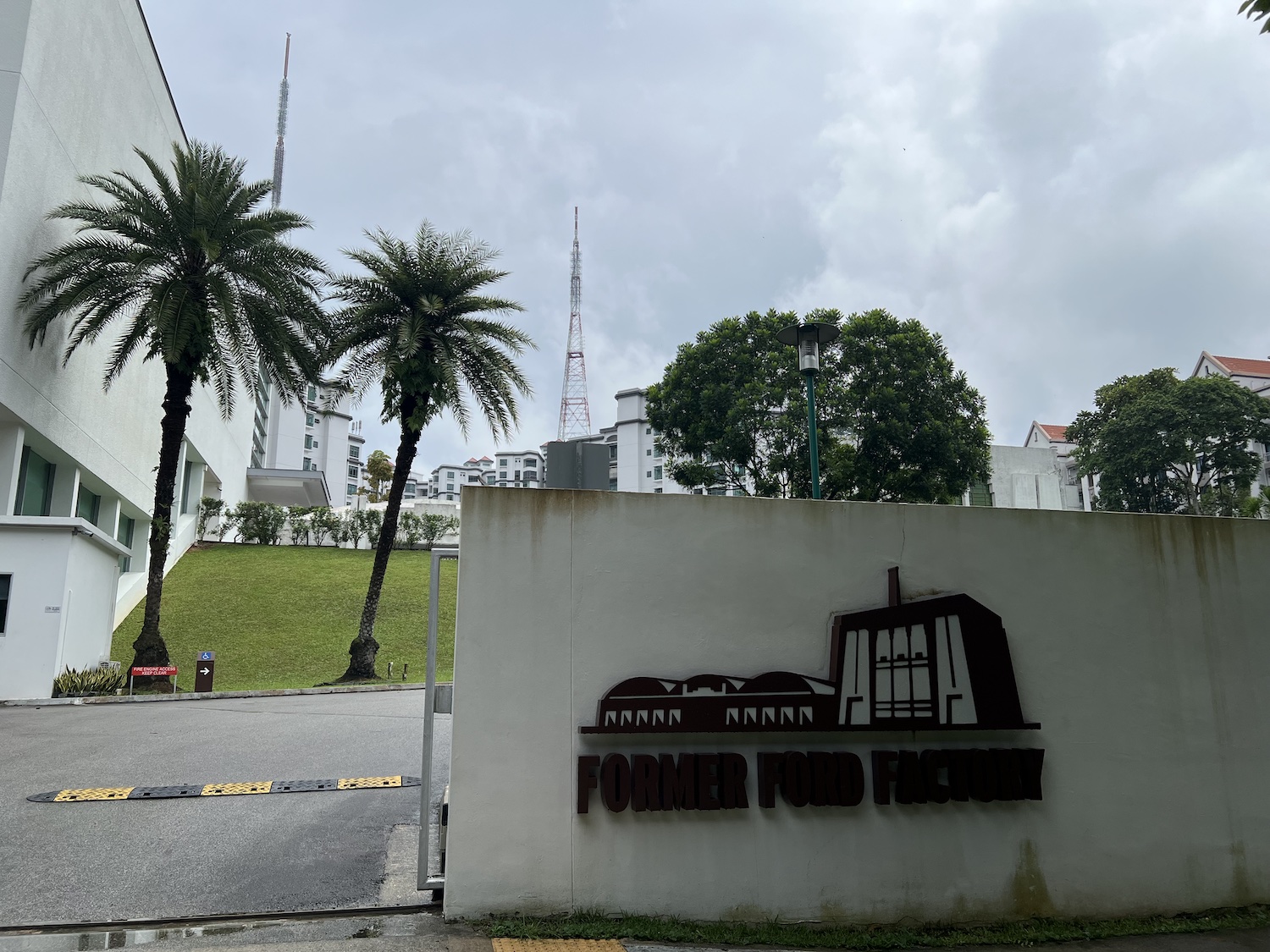
Let me answer that question just for myself – it has taken me almost thirteen years to visit The Former Ford Factory which is less than a km from my home. It is literally on Upper Bukit Timah Road, and I pass it every time I head for a walk that takes me all the way around Bukit Batok Park. It is the nearest historic monument, open most days and is free for citizens and permanent residents of Singapore. Yet, I chose to ignore it.
Finally the time was right. A rainy Friday afternoon. Alone at home. No plans for anything for the day or the evening.
I stepped out with an umbrella and into the wet parking lot where steps led me to the building that was the Former Ford Factory.
Historical significance
The Former Ford Factory was gazetted as a National Monument in 2006, and converted into an exhibition gallery and archive named Memories at Old Ford Factory.
The building that currently stands at the location is one of the buildings of the Ford factory where cars were built. However, not long after the factory became operational in 1941, ripples of WWII were felt all over the world including East and South East Asia. The most famous room of this museum is the former board room where the British troops,though larger in number, surrendered to the Japanese on 15 Feb 1942. The next three years, until the war ended and Japan surrendered, were years of great suffering for the local population.
This monument/museum tells the story of those years and the subsequent decades as Singapore came into its own. Through visuals, remnants of the past (ration card, newspaper particles, radio transmitters etc) and recordings of oral history from survivors of those horrific times, the museum recreates the past. Except for two men who were reading the details in the board room, I was the only other visitor,wandering around, reading, taking a few select pictures, marveling at the stark contrast of the war years and the Singapore of today.
Quotes from excerpts of oral interviews are printed on the walls. One bears a quote by Winston Churchill that summarises the 15 Feb 1942 event as “ the worst disaster and largest capitulation in history”. A series of boxes tell us how the price of a dozen eggs skyrocketed between 1941 and 1943. Photos and stories of hardship of people during those years are tastefully displayed along the walls.
Not a fan of war and violence
Perhaps the reason I have stayed away from this neighborhood site of historic importance was the fact that it was a reminder of the violence of the not-so-distant past. I am not a fan of war (I doubt most people are). But I take it to an extreme. As a rule, I don’t watch war movies, I don’t read war narratives or even historical fiction set against the backdrop of war.
I wonder if I am a scaredy cat. Or too soft? Or too rigid?
War is never pleasant, yet, every generation has directly or indirectly faced its consequences in terms of disturbance, discord or displacement. I don’t want to wallow for hours (through movies, shows) or hundreds of pages in (books) in which the central story cannot be narrated without describing the worst behavior that humans are capable of.
There is enough sadness, injustice and suffering in the world without the explicit trigger of warfare. It is inexcusable that neither the collective memory of recent wars nor the presence of monuments erected long ago serve as deterrents to warmongers. Yet, there seems to be value in preserving history for its own sake, to not deny the zigzag path of human evolution where we can observe how we are destined to repeat history despite our propensity to archive its details.
The Former Ford Factory museum records the building of Singapore after the end of the War and features artwork, paintings, quilling, clay pieces by students. These intriguing pieces represent the darkness and the emerging light, the despair and the hope, the past and the present side by side.
History, after all, is not simply an accumulation of facts but also the very flawed and subjective interpretation of what it means to be human. And therefore despite my considerable procrastination, I am glad I visited this monument. As the saying goes, better late than never.


0 Comments